Audiology didn’t start in a lab—it started on the battlefield. Modern hearing care has its roots in World War II, when widespread hearing loss sparked a revolution in audiology.
Decades of innovation later, the field has transformed how people experience sound, culminating in today’s more accessible solutions like OTC hearing aids. Read more to learn how audiology evolved from wartime necessity to everyday empowerment.
What Is Audiology? And What Does It Mean?
Audiology is the science of hearing, balance, and related disorders, with a focus on protecting and improving overall hearing health. Audiologists provide specialized hearing care, including diagnosing hearing loss, managing balance conditions, and recommending solutions that support clear communication and daily functioning. According to the World Health Organization, (WHO) healthy hearing is essential for communication, social connection, and quality of life.
The meaning of audiology comes from the Latin word audire, meaning “to hear,” and reflects the field’s foundation in hearing science. As the American Speech-Language-Hearing Association explains, audiology became officially recognized in the mid-20th century as hearing loss emerged as a widespread medical and social issue, particularly after World War II.
Early audiologists focused on diagnosing hearing loss, measuring auditory function, and providing hearing rehabilitation to help people communicate more effectively in everyday life. From the start, the goal of audiology was practical and patient-centered: helping individuals hear better, not just studying sound in a laboratory setting.
Early History of Hearing Loss Treatment
Before the development of modern medicine, the history of hearing loss was shaped by limited scientific understanding and social misconceptions. Hearing loss was often viewed as an inevitable part of aging or even a personal failing, rather than a medical condition. This meant few effective treatments were available.
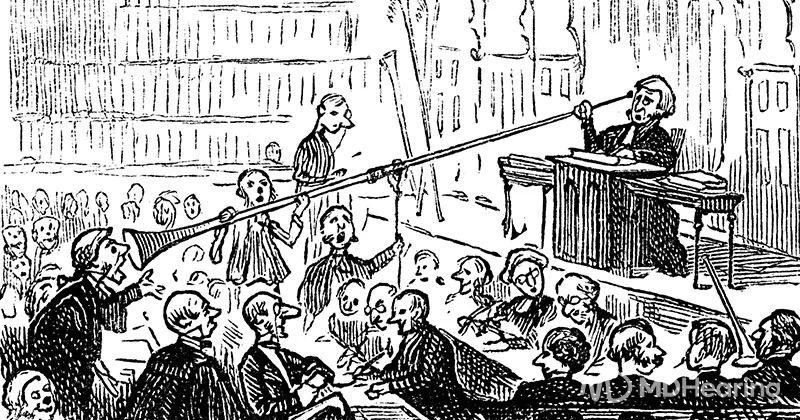
According to the National Institute on Deafness and Other Communication Disorders, early societies had little knowledge of how the ear functioned, and hearing difficulties were rarely diagnosed or treated in a clinical sense. Instead, people relied on hearing assistance devices such as ear trumpets, which appeared as early as the 17th century. These funnel-shaped devices passively amplified sound by collecting it and channeling it into the ear.
By the late 18th century, ear trumpets became more widespread and were often custom-made for individual users. The National Museum of American History at the Smithsonian Institution holds examples of ear trumpets and conversation tubes in its collection, illustrating how these devices functioned as early mechanical hearing aids.
World War II and the Birth of Audiology
During World War II, the modern field of audiology began to take shape in response to widespread noise-induced hearing loss among soldiers, caused by prolonged exposure to gunfire, explosions, and machinery. Many service members returned home with significant hearing loss and difficulties in communication and speech recognition long after the war.
According to the American Academy of Audiology, this influx of injured soldiers prompted clinicians and researchers to shift their focus from basic psychoacoustics to hearing rehabilitation.
As a result, audiology emerged as a profession, marked by the establishment of the first academic audiology program at Northwestern University in 1946 under pioneers like Dr. Raymond Carhart, often referred to as the “grandfather of audiology.” Through collaboration between doctors, scientists, and rehabilitation specialists, advances in hearing and balance science were translated to real clinical practice, laying the foundation for audiology as a distinct discipline focused on assessment, treatment, and long-term support for people with hearing loss and balance disorders.
Modern Hearing Solutions and What Comes Next
Over decades, hearing aids have evolved significantly, transforming how audiology is practiced and expanding access to hearing care. The National Institute on Deafness and Other Communication Disorders explains that ongoing research and innovation have moved hearing aids beyond simple amplification, allowing them to process sound and adapt to different listening environments. These advancements have improved sound clarity, comfort, and ease of use, making hearing aids more effective for everyday life. As a result, hearing care became more accessible and helped audiology grow from a niche medical service into widespread support that improves quality of life for millions of people.
Modern hearing care now extends beyond traditional clinics with the introduction of over-the-counter (OTC), FDA-registered hearing aids, making hearing aids more accessible and convenient than ever before.
In 2022, the U.S. Food and Drug Administration formally recognized OTC hearing aids for adults with perceived mild to moderate hearing loss, allowing them to be purchased without a prescription. This reduces barriers such as cost, scheduling, and required clinic visits, while audiology expertise remains essential in design, tuning, and support.
Looking ahead, the future of hearing aids centers on innovation, accessibility, and personal empowerment. The creation of the OTC hearing aid category supports greater independence and flexibility by allowing individuals to take a more active role in managing their hearing health. As hearing care continues to evolve beyond traditional clinical settings, the emphasis is moving toward everyday usability, confidence, and meaningful connection—an approach that aligns with MDHearing’s mission to make better hearing more accessible to everyone.
MDHearing offers advanced, affordable FDA-registered OTC hearing aids backed by support from licensed hearing professionals—making it easier for millions to hear clearly, confidently, and on their own terms.
Learn more MDHearing's modern, convenient hearing solutions today.
EXPLORE HEARING AIDS